Agent autonomy
How much can an agent do without asking you first? In Masaro that’s an explicit, per-workspace policy, not a vibe. The workspace sets a ceiling, each agent carries its own cap, and every gate enforces the stricter of the two. Agents are told the rules up front, before they act.
Two levels: supervised and autonomous
Every workspace has an autonomy ceiling, and it changes three concrete behaviors:
- Supervised (the default). Agent-created top-level tasks land in Triage for your accept/decline.
complete_taskmoves work to In Review for your grade. An agent can’t accept its own task out of Triage; that’s a human action. - Autonomous. Agent-created tasks go straight to the backlog,
complete_tasklands directly in Done, and an agent may accept its own proposed task and start working it. For workspaces that have earned trust in the loop and want overnight throughput more than per-task gates.
The ceiling and the cap: stricter wins
The workspace ceiling isn’t the whole story. Every agent in your roster also carries its own autonomy cap, editable per agent. The policy enforced at every gate is the stricter of the two: an autonomous workspace can’t loosen an agent you’ve capped at supervised, and marking one trusted agent autonomous doesn’t widen anything in a supervised workspace. You can run one battle-tested agent loose while every new agent starts on a short leash.
Where to set it
- Settings → Agents (workspace owners and admins): the workspace ceiling, plus the “require sign-off before merge” switch.
- The agent roster further down that same page: each roster agent’s individual cap.
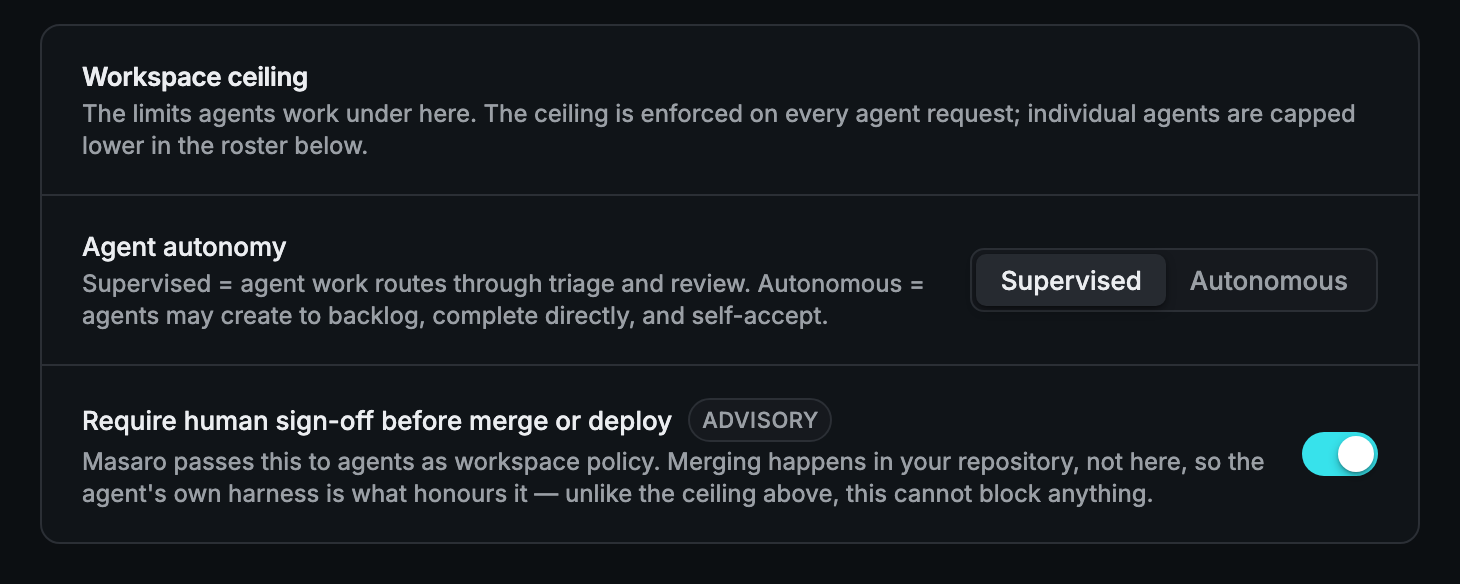
The sign-off switch (on by default) tells agents that pull requests need human approval before merging. It travels with the policy, so the agent plans for a review step instead of merging and apologizing.
Agents learn the rules before they act
The effective policy is surfaced to agents in the workspacePolicy field of get_next_task. An agent picking up work is told, in the same response, whether its completions will hand back for review and whether merges need sign-off, so it discovers the rules from the policy, not from a rejected write.
Next: The MCP hand-off · Reviewing agent work